The Alchemy of Time
Infusion is the process of extracting chemical compounds—essential oils, esters, and tannins—from botanicals into a liquid solvent. In mixology, our solvent is alcohol, which is exceptionally efficient at pulling these molecules from their sources. Unlike distillation, which uses heat, infusion relies on steady-state immersion and time, resulting in a flavor profile that is fresh, organic, and vibrantly alive.
The Three Pillars of Infusion
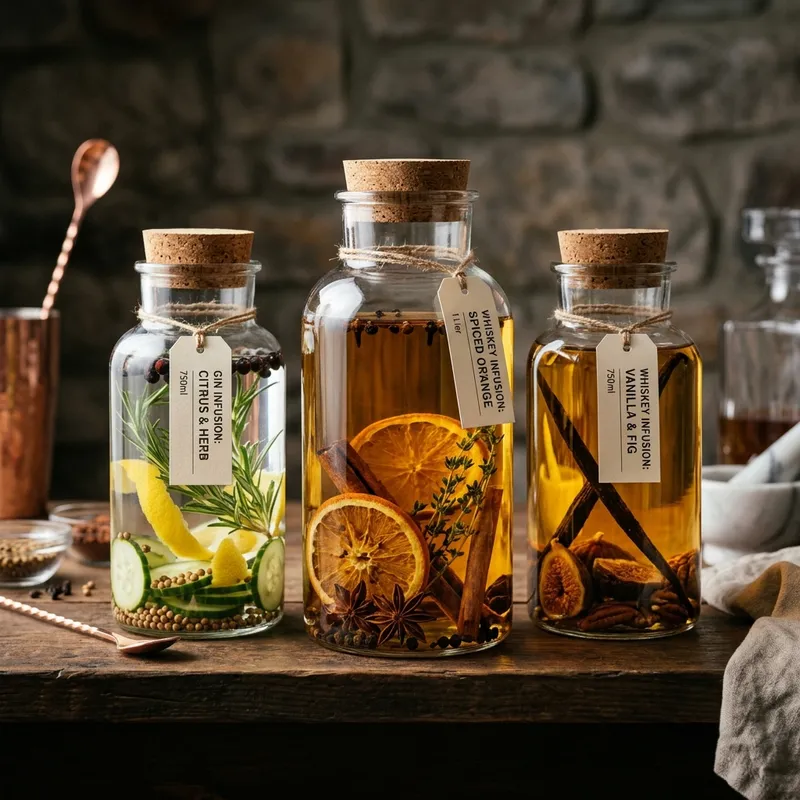
- 1. The Base Spirit: Choose a 'clean' spirit like Vodka for pure flavor expression, or a 'structured' spirit like Gin or Rye to create complex layers. The proof matters; higher ABV (50%+) extracts faster but can be more aggressive.
- 2. The Botanicals: Freshness is paramount. Citrus zest, ginger, vanilla beans, and whole spices (like star anise or peppercorns) provide the most stable and concentrated flavors.
- 3. Temperature and Light: Keep your infusion in a cool, dark place. Light and heat catalyze unwanted oxidation, which can turn bright floral notes into bitter, metallic ones.
The Infusion Timeline
- Rapid (2-4 hours): High-surface area items like chili peppers or loose-leaf tea. Be careful—over-extracted tea becomes brutally tannic.
- Standard (2-4 days): Most fruits, ginger, and zest. This allows the water-soluble and alcohol-soluble flavors to find an equilibrium.
- Slow (1-2 weeks): Hard spices, nuts, and fibrous barks. These require time to penetrate the cellular walls of the ingredient.
The Taster's Rule
"Never 'set it and forget it.' Taste your infusion every 12 hours. Flavor extraction is non-linear; it can go from 'subtle' to 'overwhelming' in a single afternoon. When it hits the sweet spot, strain it through a fine-mesh nut milk bag or coffee filter immediately."